
When kids go back to school, many caregivers focus on school security, educational quality, and the child’s mental health. One expert advises caregivers to add to this list.
Charles Broadhead, a former Statesboro police chief and current lecturer at Georgia Southern University, says scammers are finding new ways to target parents, students and families.
Broadhead says criminals may pretend to be teachers, school officials or even other parents to gain trust. They may send mass text messages, create group chats or offer fake deals in an attempt to get people to share money or personal information.
“These cybercriminals are pretty smart and very crafty,” Broadhead said. Scammers often create a false sense of urgency, hoping victims will act quickly instead of taking time to verify the information, he added.
“It can be very enticing to say, wow, I could use a break on a backpack or a break on school supplies, and that’s why they want to get you when you feel vulnerable or a little bit desperate,” Broadhead said.
Broadhead says an urgent request to make a payment or click a link should be considered a warning sign. He also warns college students to be cautious of fake scholarship opportunities. Broadhead says legitimate scholarships typically do not require students to pay money upfront.
He recommends students verify scholarship offers directly with their college or university before providing any personal information.
What Is Fraud Under Georgia Law?
In Georgia, fraud can be a state or federal felony. In both jurisdictions, fraud is basically a material misstatement calculated to deprive an owner of property.
A “material misstatement” is a rather nebulous phrase that usually means lying about the essence of the fraud. Generally, reliance is a key concept for a Marietta criminal defense lawyer. If the prevarication prompted the exchange, fraud charges could hold up in court.
Don’t miss “calculation,” which is a connection between the lie and the gain. A sob story, even a greatly exaggerated sob story, may not satisfy this element. Frank must lie to Peter to get his money, not to stir Peter’s sympathies.
Finally, the fraudster must obtain something material. Non-financial fraud is unsettling, but not illegal, at least in most cases.
How Georgia Prosecutors Handle State Fraud Charges
Georgia Code § 16-8-3 defines fraud as obtaining property from another person by deceitful means or artful practice with the intent to deprive them of it.
The “I don’t have anyplace else to go” fraud, or some variation of it, is a very common back-to-school personal fraud.
Assume Julie and her mother, Anna, get in a violent argument over Julie’s boyfriend. Heated words are exchanged and Anna tells Julie to get out and never come back. Julie tells Michelle about Anna’s ultimatum. Julie doesn’t tell Michelle about the context. A sympathetic Michelle buys Julie a new phone, takes her shopping for new clothes, and so on.
A few days later, as they have before, Michelle and Anna reconcile. Michelle goes home with her new clothes, new phone, and whatever else Julie bought.
If Julie files a complaint, or if authorities otherwise get wind of the situation, fraud charges could hold up in court. For a Marietta criminal defense lawyer, the two main issues are Julie’s cooperation, or lack thereof, and Julie’s tall tale.
Technically, Julie is a complaining witness. She doesn’t have the power to “drop” criminal charges. Indeed, the state may not need her testimony to move forward, if other evidence is available, like another eyewitness.
However, if Julie isn’t interested in the case, Cobb County prosecutors most likely won’t care about it either. So, a Marietta criminal defense lawyer may delay the proceedings as long as possible. As the months roll by, Julie’s ire fades away.
Voluntary restitution payments may be part of the strategy. Technically, the offense was complete when Michelle took money. But if Julie gets her money back, she may see little point in a criminal case.
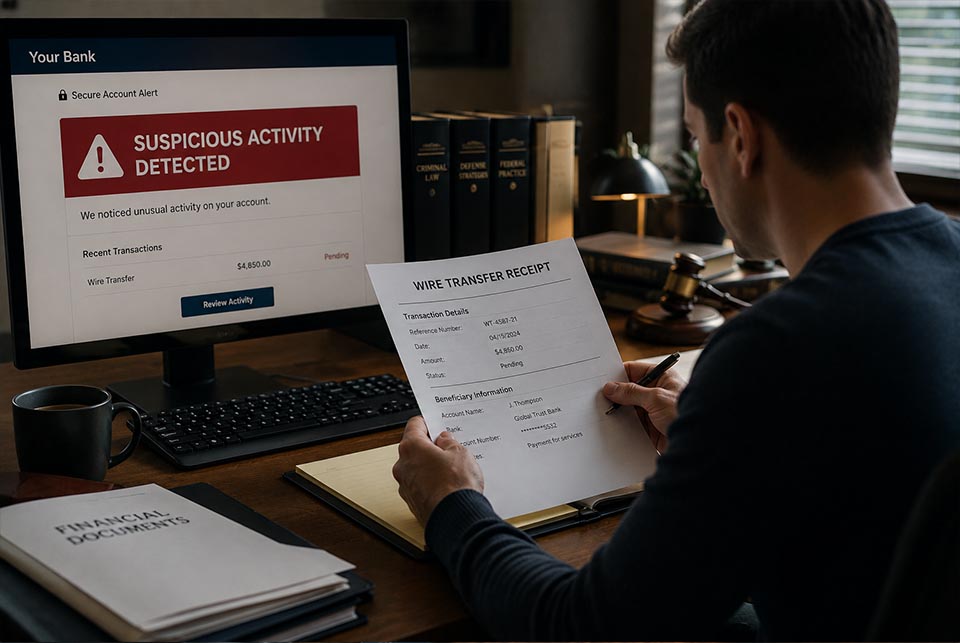
When Fraud Becomes a Federal Crime
Most federal fraud criminal cases are widespread schemes, mostly because of the interstate commerce rule. Even if the fraud occurred entirely within Georgia, the case could be a federal case: Examples include:
- Mail Fraud: If Paul mails a letter to any address, even if it’s next door, the use of federal mail makes the fraud a federal offense. On a related note, many mail fraud and related cases involve hundreds of indictments. Every letter, even if it’s the same form letter, is a separate offense.
- Financial Institution Fraud: Insurance, bank, and state tax fraud are almost always federal offenses. Most financial institutions, even “local” ones, have offices or divisions in other states. Even if that’s not the case, with state tax fraud, fraudsters usually mail items or send them over the internet.
- Computer Fraud: These cases often have issues, but jurisdiction isn’t one of them. If equipment was manufactured out of state, and it probably was, the offense occurred in the stream of interstate commerce.
The quest for material gain is the main issue in many computer fraud and other cases. Many people hack into computer networks to embarrass the organization or prove to themselves that they can do it.
How Federal Fraud Cases Are Investigated
Federal fraud investigations can be lengthy and may begin before a person realizes they are a target. Investigators may review financial records, emails, text messages, business documents, bank transactions, tax filings, and other evidence.
Federal agencies may also conduct interviews, execute search warrants, issue subpoenas, or use other investigative techniques. In some cases, prosecutors may rely on cooperating witnesses or individuals who have entered plea agreements.
A person under investigation should generally avoid discussing potentially incriminating facts with investigators without first consulting a federal criminal defense attorney. Statements made during an investigation can potentially become evidence in a future prosecution.
Penalties for Federal Fraud Convictions
Federal fraud convictions can carry significant consequences. Depending on the offense and circumstances, penalties may include imprisonment, substantial criminal fines, restitution to victims, and forfeiture of assets allegedly connected to criminal conduct.
The potential sentence can depend on numerous factors, including the amount of financial loss, number of victims, defendant’s role, sophistication of the alleged conduct, criminal history, and other sentencing considerations under the Federal Sentencing Guidelines.
As mentioned above, certain fraud cases can also involve multiple counts, meaning a defendant may face several separate charges arising from the same investigation.
Defenses to Federal Fraud Charges
The appropriate defense depends on the facts and evidence in the individual case. Potential defense strategies may include challenging whether the defendant had fraudulent intent, disputing the government’s interpretation of financial transactions, questioning the reliability or admissibility of evidence, or arguing that the defendant did not knowingly participate in the alleged scheme.
In some cases, defense attorneys may also challenge evidence obtained through unlawful search or seizure or investigate whether statements were improperly obtained.