
We receive this message quite often, especially between Memorial Day and Labor Day. Hot weather causes tempers to flare and alcohol consumption increases during the summer. Most Georgians have never been through the criminal justice process, and, in an hour of need, many don’t even know where to begin. This step-by-step guide is for these individuals.
The release process from the Cobb County Adult Detention Center is a structured legal procedure designed to ensure that individuals are released only after all court orders, financial obligations, and administrative requirements have been satisfied. While the exact timeline varies depending on the circumstances of the case, understanding each step of the release process can help defendants, family members, and Marietta criminal defense lawyers know what to expect.
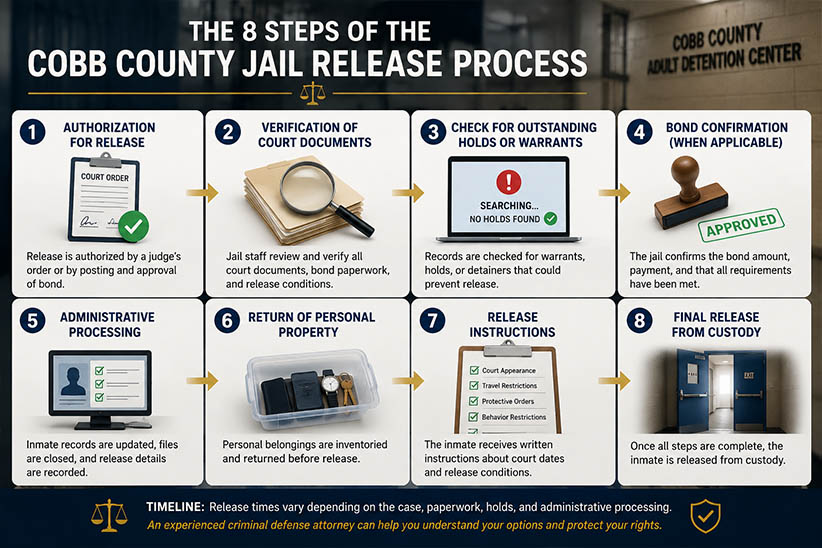
Step 1: Get Authorization for Release from Cobb County Jail
For purposes of this guide, Step One is almost always a bond posting and approval or a Cobb County judicial order.
The sheriff must approve all cash or, if available, cash-equivalent bonds. The sheriff must also approve all bail bonds. Basically, the issuing company must be licensed and in good standing. A judge may approve pretrial release, usually after a bond reduction hearing.
Jail staff cannot release an inmate until official documentation is received and verified. Even if a judge orders release in court, the detention center must receive the appropriate paperwork before processing begins. In other words, delay is inevitable.
Step 2: Cobb County Jail Verifies Court Documents
After receiving release authorization, jail personnel review all legal documents to ensure they are complete and accurate. Staff verify:
- The inmate’s identity,
- Case information,
- Court orders,
- Bond documentation, and
- Release conditions.
If any documents contain errors or missing information, the release may be delayed until corrections are made.
For those of you keeping score at home, Step 1 seems very similar to Step 2. Most people value efficiency, which is getting more things done in less time. The Cobb County criminal law process values inefficiency. Redundancy is the order of the day. Instead of one person handling two or three tasks, two or three criminal justice workers typically handle one task.
Step 3: Check for Outstanding Warrants or Holds
The cell doors are still nowhere near swinging open. Before an inmate is released, detention staff conduct a records check to determine whether any additional legal holds exist. Examples include:
- Outstanding warrants,
- Probation or parole holds,
- Immigration detainers,
- Holds from another county or state, and
- Additional pending criminal charges.
If another agency has placed a valid hold on the inmate, the person will not be released even if the current case has been resolved.
This step may be the biggest roadblock in the jail release process. Normally, a Marietta criminal defense lawyer must resolve the ancillary matter before jail officials move forward with the release process. This resolution often requires a personal appearance in another court.
Step 4: Confirm the Cobb County Jail Bond
We touched on the bail bond process above. If release depends upon posting bond, and it normally does, the jail verifies that:
- The correct bond amount has been paid,
- Payment has cleared,
- Any required documents are complete., and
- A bondsman has satisfied all applicable requirements, if one is involved.
Cash bail is essentially a security deposit. The defendant, or an agent, puts up the entire amount. Then, when the case is resolved, the county refunds most of the deposit.
Bail bonds are essentially insurance policies. If the defendant doesn’t appear at trial or violates another release condition, the bonding company bears the financial risk.
Step 5: Complete the Jail’s Administrative Processing
Now, we’re approaching the downhill run. Once legal requirements have been satisfied, detention staff begin administrative processing. This step includes:
- Updating inmate records,
- Closing the booking file,
- Recording the release date and time,
- Preparing discharge documentation, and
- Removing the inmate from the jail housing roster.
Administrative processing helps ensure that official records accurately reflect the inmate’s change in custody status.
Step 6: The Inmate’s Personal Property Is Returned
When an inmate was booked into the Cobb County jail, personal belongings were inventoried and stored. Before release, staff return these items, which may include:
- Wallets,
- Identification cards,
- Cell phones,
- Keys,
- Jewelry,
- Clothing, and
This process involves a thorough property search and, in many cases, additional “where did you get this item” interrogations. If authorities file additional charges, such as possession of an illegal substance or possession of stolen property, the process grinds to a halt.
Step 7: Review Bond and Release Conditions
Depending on the circumstances, the inmate may receive written instructions explaining future legal obligations. These may include:
- Court Appearance: Some judges require defendants to appear at procedural pretrial hearings, in addition to resolution hearings.
- Travel Restrictions: Remaining in the state or county is a common release condition. If the defendant was just passing through, a Marietta criminal defense lawyer must often make special arrangements.
- Protective Orders: A civil protective order is almost always part of the assault criminal process, especially in family violence matters.
- Behavior Restrictions: Failure to report to a supervision officer, fulfill ancillary requirements, such as an IID in a DUI, usually leads to bond forfeiture proceedings.
If the judge revokes bond or another release order, the defendant is subject to re-arrest at any time and in any place.
Step 8: Final Release from Cobb County Jail
After all processing has been completed, jail staff escort the individual through the discharge area and release them from custody.
Family members or friends often wait outside the facility to provide transportation, although released individuals may leave on their own if legally permitted.