
In September 2026, the Georgia Parole Board interviewed crime victims from throughout the state during meetings in Valdosta.
“Victim Impact is a part of the consideration process,” remarked Board member Josh Waters. When making a parole decision, the Board reviews all case information including victim information as well as progress of the offender during incarceration. Victim Impact Sessions are a collaboration involving the Georgia Parole Board, the Georgia Office of Victim Services, and the local district attorney. Waters met individually with victims in five different criminal cases.
“We met with victims to provide them with the opportunity to tell the parole board about the crime and how it has affected their lives,” Waters explained.
Brad Shealy, the district attorney for the Southern Judicial Circuit, echoed Waters’ sentiment. “It is important that crime victims continue to have the opportunity to stay involved in the case,” Shealy said. “Victims have the opportunity to send the parole board information, but it is impactful to hear firsthand from them and I applaud the board for providing this platform.”
The cases of the offenders involving the victims have been scheduled for consideration by the Parole Board according to their statutory parole eligibility date.
Probation vs. Parole in Georgia: What’s the Difference?
Unless the defendant has a terrible prison record, parole is usually an option, except in the most serious cases. Similarly, unless a defendant has a long criminal record, probation is usually an option, except in the most serious cases.
These programs are not available because the GPB is magnanimous or prosecutors are generous. Georgia’s prison budget is almost $2 billion a year, and Cobb County spends millions of dollars per year on county jails and other such facilities.
So, for government bureaucrats, probation and parole are money-saving devices. These programs cost money too, but not nearly as much. Furthermore, defendants usually pay supervision and other fees that partially offset program costs.
Supervised release basically gives defendants a chance to prove themselves. In most cases, they only get one chance. Any violation, especially any probation violation, could mean probation violation.
Probation violations are especially common in Georgia. The Peachtree State doesn’t closely limit probation terms. Longer terms mean more opportunities to mess up.
Therefore, for a Marietta criminal defense lawyer, obtaining supervised release is often the easy part. Keeping a defendant on supervised release, and out of jail or prison, is usually the hard part.
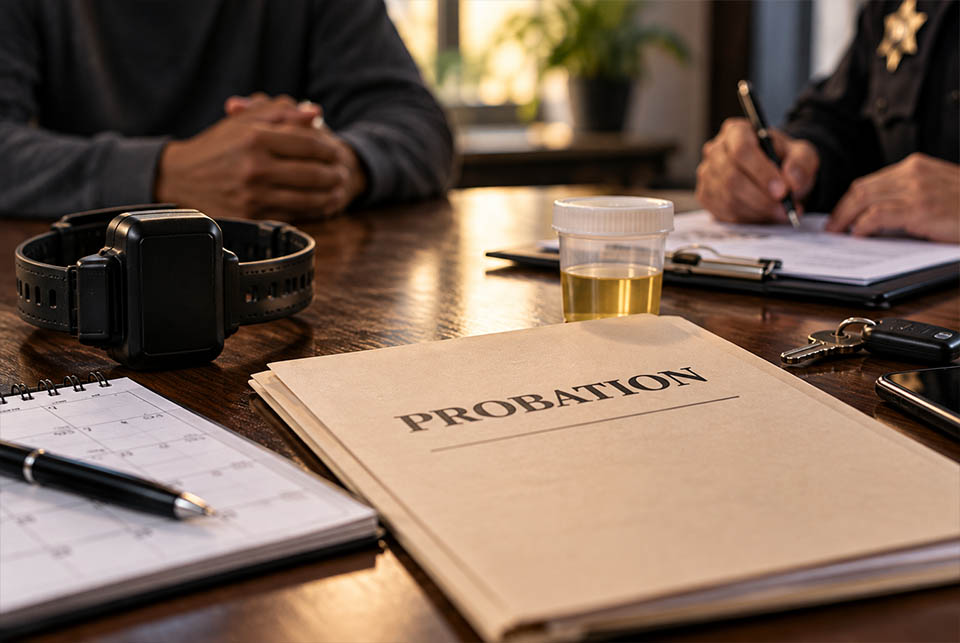
Common Probation Violations in Georgia
Understanding the common probation violations in Georgia helps defendants recognize their obligations and avoid additional legal consequences.
Missing an Appointment With Your Probation Officer
One of the most common probation violations is failing to report as directed. All probationers generally must maintain regular contact with their supervising officers and comply with scheduled appointments.
Missing an appointment, failing to respond to required communications, or otherwise neglecting reporting requirements can result in a violation. Additionally, failure to provide required documents, like copies of employment or school records, are tantamount to failure to report in many cases.
The immediate intervention of a Marietta criminal defense lawyer often makes a difference. Especially if the defendant has a legitimate excuse for missing the meeting, failing to provide documents, or committing another transgression, an attorney’s phone call or personal appeal often convinces probation officers to give defendants second chances.
Getting Arrested While on Probation in Georgia
People on probation must obey federal, state, and local laws. Being arrested or convicted for a new offense can therefore create additional problems while someone is already under supervision. The Georgia Department of Community Supervision specifically identifies compliance with all applicable laws as a standard condition of supervision.
A new criminal offense may be treated differently from a technical violation because it involves alleged criminal conduct rather than simply failing to comply with an administrative or supervision requirement.
Some adverse action is usually inevitable in these situations. An attorney reduces this adverse action as much as possible. Available options include extending the period of probation, agreeing to additional restrictions, or serving a few days in jail as a condition of reinstatement.
Failing a Drug or Alcohol Test While on Probation
Alcohol or drugs are a factor in an estimated 80 percent of crimes committed in Georgia. The involvement could be direct (DUI or drug possession) or indirect (defendant was under the influence of drugs and/or alcohol when the offense was committed).
Courts almost always impose alcohol or drug tests as a condition of probation in these cases. These conditions may or may not include abstinence.
A positive test, refusal to test, or failure to participate in required substance-abuse treatment may potentially constitute a violation depending on the person’s specific conditions.
A Marietta criminal defense lawyer can challenge the test results, usually based on the sample method or the sample’s handling.
Traveling Without Permission While on Probation
Probation conditions can restrict where a person may travel or require permission before leaving Georgia. This restriction usually applies to any out-of-state travel, such as leaving the state for work or visiting a newborn nephew in Tennessee.
Once again, a Marietta criminal defense lawyer often makes a difference. Attorneys help probationers obtain special permission for out-of-state travel, thus avoiding adverse consequences.
Failing to Complete Treatment, Employment, or Other Requirements
Georgia probation conditions can include requirements related to employment, education, treatment, counseling, or community service. DCS lists suitable employment and compliance with certain rehabilitative services among supervision requirements.
Courts can also impose special conditions, such as obtaining a GED, completing alcohol or drug treatment, observing a curfew, or complying with a no-contact order.
A motion to modify the conditions of probation may fit the bill in these cases. Georgia law gives judges almost unlimited power to modify the conditions of probation at any time. This modification could include conversion to unsupervised probation. These defendants must only avoid trouble with the law and wait for the probation clock to wind down.
The opposite is also true. Judges may tighten the screws for almost any reason, or for no reason at all. Therefore, an ongoing partnership with a Marietta criminal defense lawyer is essential.
Falling Behind on Fines, Fees, or Restitution
Depending on the sentence, probation may require payments toward fines, fees, or restitution. DCS identifies restitution, fines, and fees as potential probation requirements.
Probationers who cannot make required payments should not simply ignore their obligations. The appropriate response can depend on the court’s order and individual circumstances.
These violations often don’t hold up in court because they arguably transform state or county detention facilities into debtors’ prisons, which are illegal in the United States.
Staying on probation is often more difficult than getting on probation. For a free consultation with an experienced criminal defense attorney in Marietta, contact the Phillips Law Firm, LLC. The sooner you reach out to us, the sooner we start working for you.