
Quite possibly. Hit-and-run is usually a misdemeanor in Georgia, especially if the accident was hitting an unoccupied parked car or an intersection fender-bender. Hit-and-run is a felony if the accident proximately caused death or serious injury (putting someone in the hospital).
State law requires both drivers to stop at or near the scene of the collision while minimizing traffic disruption, disclose certain personal information (name, address, and vehicle registration number), show a drivers’ license upon request, and provide minimal assistance to injured victims. Minimal assistance is usually calling 9-1-1. Minimal assistance rarely includes actions like pulling victims to safety.
Drivers who remain at the scene but don’t fulfil all these obligations could be charged with failure to report, which in terms of direct consequences isn’t as serious as hit-and-run, but in terms of indirect consequences is almost indistinguishable from hit-and-run. More on that below.
The failure to report law gives a Marietta criminal defense lawyer a lesser-included offense to use during plea negotiations. Many prosecutors jump at such plea bargain offers, because the defendant is convicted of something. These arrangements also benefit defendants, because the punishment is lower and probation is easier to complete.
Can You Go to Jail for a Property-Damage Hit-and-Run in Georgia?
In many states, the answer to this question is “no.” PDO HAR is a civil infraction. But in Georgia, you can go to jail if you do not remain at the scene of an accident until the aforementioned requirements are completed. Regardless of the amount of property damage (if greater than $1) or degree of personal injury, a first-time violation could mean a maximum:
- $1,000 fine (minimum $300 fine),
- Twelve months in jail, or
- Both.
The court could suspend or probate all or part of the jail sentence. The fine cannot be probated, suspended, or stayed.
When Does Hit-and-Run Become a Felony in Georgia?
All accidents cause injuries. Frequently, those injuries are minor and temporary, such as headache or neck soreness. Hit and run is a felony in Georgia if the accident caused a serious injury, which the law defines as:
- Depriving a person of a body part,
- Rendering a body part useless (paralysis),
- Bruising, scarring, or other serious disfigurement, or
- Causing a traumatic brain injury.
Note that the law requires a “serious” injury, not a “permanent” injury. Also note that, with the exception of a TBI, prosecutors don’t need medical evidence to prove a victim sustained a serious injury. Also recall that this injured person doesn’t have to be the person who was the “accident victim.” The at-fault driver could be the injured party.
A felony conviction, especially for a reckless offense like hit-and-run, has consequences far beyond the possible prison sentence, which could be between one and five years.
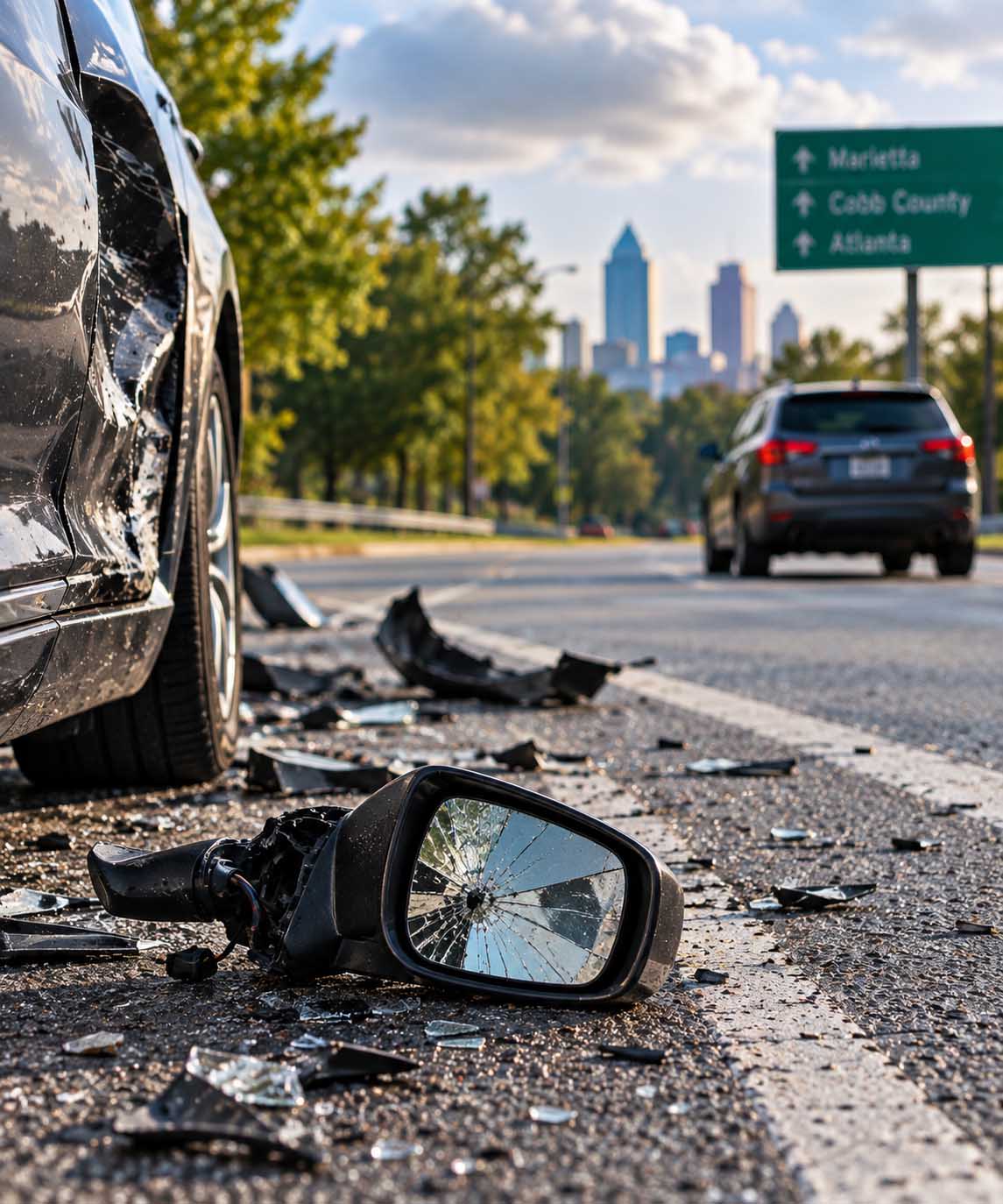
What Happens After a Fatal Hit-and-Run in Georgia?
Georgia’s hit-and-run law doesn’t include an additional enhancement if the accident caused a fatal injury. However, in these cases, Cobb County prosecutors routinely add additional charges, generally some form of vehicular homicide.
- First-Degree Vehicular Homicide: These charges could hold up in court if the defendant was under the influence of alcohol or another substance at the time of the wreck, or if the wreck involved hit-and-run, reckless driving, or fleeing from police.
- Second-Degree Vehicular Homicide: The state usually files these charges if a lesser traffic violation (speeding, failing to yield the right-of-way, following too closely, etc.) substantially caused the crash.
Some driver impairment cases, such as extreme fatigue, could be first-degree (felony) or second-degree (misdemeanor) vehicular homicide.
Are Penalties Higher for Repeat Hit-and-Run Offenses in Georgia?
For a second conviction within five years, the law increases the minimum fine, in a misdemeanor or felony, to $600.
For a third or subsequent conviction within that period, the minimum fine is $1,000, with imprisonment of up to 12 months, or both. Certain prior nolo contendere pleas are convictions for purposes of these provisions.
Can Your License Be Suspended for Hit-and-Run in Georgia?
For sure. In fact, drivers’ license suspension may be the most common, and most serious, indirect consequence of a hit-and-run conviction. Usually, the court will suspend the defendant’s license for between four and twelve months. A limited license may be available during that time period.
Note that, when the suspension period expires, the defendant’s license is still invalid until the defendant pays a reinstatement fee, provides proof of insurance, and meets other qualifications.
What Are the Best Defenses to a Georgia Hit-and-Run Charge?
The lack of knowledge defense may be the most effective hit-and-run defense in these cases. A Marietta criminal defense lawyer doesn’t have to “prove” lack of knowledge. An attorney only has to create a reasonable doubt on this point.
Pedestrian hit-and-runs are a good example. Especially at night or during other low-visibility periods, if a driver brushes a pedestrian, the driver may not know if s/he collided with a person, especially if the defendant was driving a large pickup truck, SUV, or other large vehicle.
Sometimes, timing matters. If the defendant later sees damage consistent with a collision, the defendant has some duty to retrace his/her steps. But the law doesn’t require defendants to err on the side of caution or report the damage to authorities.
Yes, there’s a failure-to-report law, as mentioned above. However, that law only applies when defendants know, or should know, that collisions caused damage.
Other defenses, mostly illegal interrogations and illegal searches, may be available in some cases. Since hit-and-run is a criminal offense in Georgia, all normal constitutional protections apply.
Hit-and-run is a serious criminal offense in Georgia. For a free consultation with an experienced criminal defense attorney in Marietta, contact the Phillips Law Firm, LLC. The sooner you reach out to us, the sooner we start working for you.