
A multi-agency investigation that began in September 2025 resulted in the arrest and indictment of eight men roughly one year later.
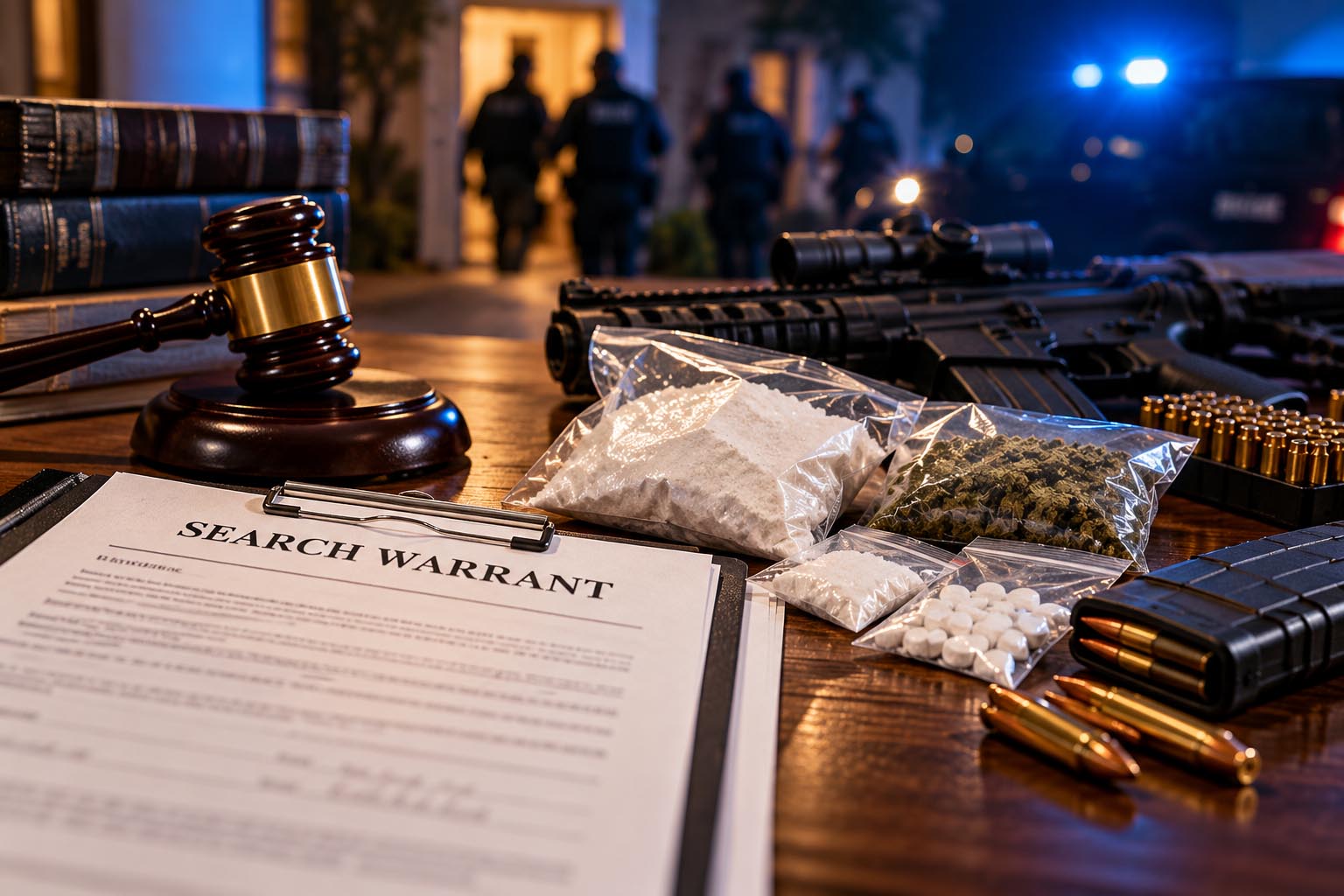
On September 10, 2026, state, local and federal law enforcement agencies served eight search warrants across Candler, Toombs, and Emanuel counties. During the raids, officers seized 28 firearms, suspected cocaine, and suspected marijuana.
Six men were arrested and booked into the Candler County Jail. Three face charges of conspiracy to distribute cocaine, possession of a firearm, and use of a communication facility to commit a felony. The other three are charged with conspiracy to sell cocaine, illegal use of a communication facility and firearm possession by a convicted felon.
Multiple agencies assisted in the operation, including the Metter Police Department, the sheriff’s offices of Candler, Toombs, and Emanuel counties, Georgia State Patrol, the U.S. Postal Inspection Service and the FBI.
No other details were available.
What Makes a Search Warrant Valid in Georgia?
Almost all extensive, multi-agency investigations involve search warrants. A Marietta criminal defense lawyer can get seized evidence thrown out of court if police officers failed to dot all the i’s and cross all the t’s.
In the United States, the Fourth Amendment generally requires law enforcement to obtain a search warrant before searching any big or small area, if any person has a reasonable expectation of privacy. A valid warrant must be based on probable cause. Requesting officers must cite sufficient facts and circumstances to reasonably believe that evidence of a crime will be found in the place to be searched. The probable cause must be supported by an oath or affirmation.
The warrant must also particularly describe the place to be searched and the persons or things to be seized. This requirement prevents overly broad or “general” searches and limits officers to the scope authorized by the warrant.
This prohibition is at the heart of the Fourth Amendment. The Founding Fathers added this provision to the Constitution, at least in part, because the British used blank search warrants (writs of assistance) to justify property searches in colonial America.
A neutral judge or magistrate must determine that probable cause exists before issuing the warrant. Law enforcement officers generally must execute the warrant according to its terms and applicable procedural rules.
There are exceptions to the warrant requirement, including consent, exigent circumstances, certain searches incident to arrest, and some circumstances involving automobiles or items in plain view. Whether an exception applies depends on the specific facts and applicable federal or state law.
As mentioned, if a search violates the Fourth Amendment, evidence obtained may sometimes be excluded under the exclusionary rule, although several exceptions can apply.
What Must Prosecutors Prove in a Georgia Drug Possession Case?
Illegal possession cases dominate many misdemeanor and felony dockets in Cobb County. Police officers forward lots of these cases to prosecutors because they generally believe possession is easy to prove. But they’re wrong. Prosecutors must prove all three elements of criminal possession beyond any reasonable doubt:
- Close Proximity: Admittedly, this element is pretty easy to prove. For example, in a vehicle, any item in the passenger area, including a car’s trunk or pickup’s bed, is closely proximate to any vehicle occupant.
- Actual Knowledge: This element is often an issue in the aforementioned vehicle possession cases. If drugs are in the glove compartment, Tim must know that drugs, not “something illegal,” are in the glove compartment.
- Exclusive Control: This element may be the most difficult one to prove. Tim doesn’t have exclusive control over items in the glove compartment, even if he owns the car, if someone is in the passenger seat.
Prosecutors must also prove any add-on charges beyond any reasonable doubt. Possession of a firearm by a felon is a good example.
The court cannot simply take prosecutors at their word on this point. Usually, prosecutors must introduce a certified copy of the conviction record into evidence. A regular copy may do, but these documents aren’t self-authenticating. If prosecutors don’t lay the proper foundation, a Marietta criminal defense lawyer can exclude the record. If that happens, the case falls apart like a house of cards.
What Defenses Are Available to Georgia Drug Possession Charges?
A wide range of affirmative defenses are available in illegal possession cases. Coercion, necessity, and entrapment may be the most common ones.
The coercion doctrine could apply if someone subtly or overtly threatened Tim into transporting or holding drugs. Time must reasonably believe that the bad guy (or bad girl) meant what s/he said and was able to carry out the threat.
Necessity could be a defense in illegal weapons possession cases, if the defendant reasonably believed s/he needed a gun to counter a greater threat. A Marietta criminal defense lawyer must also prove the defendant had no reasonable alternative. This element is often difficult to prove, because in most cases, an illegal weapon is a last resort, not a first option.
The entrapment defense, which could be used in drug possession cases, is also difficult to prove. The defendant must have no predisposition to commit the offense. So, in practical terms, the defendant must have a squeaky-clean criminal history.
How Are Georgia Drug Possession Cases Resolved?
One or more of these three defenses usually apply in most criminal matters. A lawyer uses these defenses at trial and during pretrial settlement negotiations.
Judges typically rule on procedural defenses following pretrial hearings. Technically, the case can move forward if the judge excludes evidence, but given the high burden of proof in criminal cases, without an overwhelming amount of evidence, convictions are almost impossible to obtain.
The trial factfinder (judge or jury) evaluates substantive and affirmative defenses. These evaluations are subject to appeal, but appeals courts rarely second-guess judicial colleagues and jury findings.
A procedural, substantive, or affirmative defense is also a big bargaining chip during pretrial negotiations. These negotiations resolve over 90 percent of criminal cases. A potential defense reduces the chances of a conviction, putting a defense lawyer in the driver’s seat during negotiations.
Several effective defenses are usually available in illegal possession cases. For a free consultation with an experienced criminal defense attorney in Marietta, contact the Phillips Law Firm, LLC. Virtual, home, and jail visits are available.