
The Field Sobriety Test, which usually includes the three tests discussed below, is a trap. Frequently, DUI suspects agree to take these tests because they believe if they pass the tests, the officer will release them. Usually, however, when an officer tells a suspect to step out of the car, the officer has already decided to make an arrest, and the FSTs are basically a formality. Unless suspects perfectly complete all tests, and we mean perfectly, arrests are inevitable.
Consequences of a DUI arrest include drivers’ license suspension, mandatory jail time (in most cases), and vehicle forfeiture (in a few cases).
Civil Administrative License Revocation suspension applies if the defendant refused to provide a chemical sample or failed a chemical test. Almost all DUI defendants fall into one of these two categories. Most law enforcement agencies hold DUI defendants for at least forty-eight hours. Georgia’s criminal forfeiture law could apply to a vehicle used in a DUI, but officials rarely wield this power.
A Marietta criminal defense lawyer cannot do anything to prevent an arrest, But an attorney does reduce the collateral consequences of a DUI arrest and works to keep FST evidence out of court.
Unapproved Tests
Trick questions, the Romberg balance test (or some variation of it), and counting/reciting tests are the most common unapproved tests.
According to the National Highway Traffic Safety Administration, the governing body in this area, unapproved tests are not scientifically reliable. That’s saying quite a bit, because the scientific reliability of approved tests is questionable at best. More on that below.
“What was the year of your first birthday” is the most common truck question DUI field sobriety test. Think long and hard about that one before you answer.
Tests like counting from fifty-one to seventy-two or reciting the alphabet from S to Z measure the subject’s ability to follow directions but have no relationship to intoxication.
Romberg’s balance test isn’t related to intoxication either. Many people have poor balance for many reasons. However, rather than exclude the test, a Marietta criminal defense lawyer often allows officers to testify about it. The head-back, arms-outstretched balance test measures three items:
- Proprioception,
- Vision, and
- Vestibular function.
Most people, including most officers, don’t know the meaning of proprioception or vestibular function. As a result, the officer appears incompetent at best and biased at worst.
Usually, officers first administer unapproved tests. Therefore, mentally and physically fatigued defendants do worse on the tests that really count.
Approved Tests
The three NHTSA-approved field sobriety tests are the DUI eye test, walk-and-turn, and one-leg stand.
HGN
The DUI eye test is the follow-my-finger horizontal gaze nystagmus test. Intoxication causes nystagmus, or involuntary pupil movements, at certain viewing angles. Controlled condition nystagmus tests are about 80 percent accurate. Two main problems exist.
First, intoxication is not the only cause, or even the leading cause, of nystagmus. Other possible causes include:
- Congenital nystagmus (a birth defect),
- Albinism (insufficient eye pigment),
- Retinal disorders,
- Cataracts,
- Inner ear problems,
- Stroke,
- Multiple sclerosis, and
- Brain injury.
Head injuries, usually mild childhood head injuries, are the most common cause of nystagmus. Head injury-related nystagmus is so common, and the symptoms are so mild, that most people don’t know they have this condition.
Second, roadside HGN tests are not controlled environment tests. Visual and other distractions include whizzing cars, bright headlights, and flashing strobe lights.
WAT
This test measures physical dexterity and mental acuity (ability to follow directions). As mentioned, the ability to follow directions isn’t related to intoxication. But the WAT and OLS are divided attention tests. Scientifically, intoxicated people cannot think and act at the same time. So, on the surface, these two tests are much more reliable than the eye test.
But not so fast. The HGN test and the unapproved tests resemble doctor’s office well-being tests. The WAT is the first FST that feels like a DUI test. So, most subjects panic. That panic affects their ability to walk a straight line heel to toe.
Frequently, that ability is limited. Most people can only walk heel to toe barefoot or while wearing athletic shoes. Changing shoes is never an option, and removing shoes usually isn’t an option either, at least prior to roadside tests. On a related note, roadside WAT tests usually involve imaginary lines, dark parking lots, and/or uneven surfaces.
Finally, the eye test only has three intoxication clues (lack of sustained pursuit, earky onset pupil movement, and maximum deviation nystagmus). The WAT has eight intoxication clues, such as using arms for balance, starting too soon, and failure to walk heel to toe. More clues mean more chances to fail this test.
OLS
The walk-and-turn and one-leg stand are similar in many respects, so we’ll keep this section brief.
We mentioned the shock factor above. Furthermore, by the end of the three-test battery, many defendants are severely fatigued. At the scene, officers must be satisfied that the defendant failed the test, for whatever reason. In court, the state must prove the defendant failed the tests because e/he was intoxicated, not because s/he was tired or for any other reason.
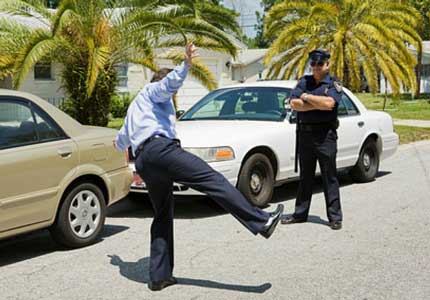
Furthermore, physical impairments loom large in the OLS. People with mobility impairments often can’t stand on one leg to save their lives. People who are overweight usually can’t stand completely still on one leg. Swaying and other issues are inevitable.
Prosecutors typically use on-the-scene field tests whenever possible. Defendants may take the same tests under somewhat more controlled conditions at the police station. But by then, many defendants have sobered up.
Proof Issues
A few final words about on-the-scene DUI field sobriety tests and proof issues in criminal court.
Because the field sobriety test has so many scientific issues, many judges only admit FST results for limited purposes. The HGN test is a good example. Many judges allow prosecutors to use these results to establish probable cause for the arrest. But they cannot use these results to prove guilt beyond a reasonable doubt.
The DUI field sobriety test isn’t a reliable indicator of intoxication. For a free consultation with an experienced Marietta criminal defense lawyer, contact The Phillips Law Firm, LLC. We routinely handle matters in Cobb County and nearby jurisdictions.