
In many states, early discharge from probation isn’t worth the effort, especially in misdemeanors. But Georgia is different.
Most states cap probation violation sentences at low levels, usually less than ninety days. But if Frank violates Cobb County probation, even misdemeanor probation, he could be incarcerated for up to two years.
Even if Frank doesn’t violate probation, this sentence is a major burden after a criminal conviction. Probation may involve regular reporting, drug testing, community service, treatment programs, travel restrictions, fines, restitution, and other court-ordered conditions. Fortunately, early discharge from probation in Georgia may be possible for qualifying individuals.
State law gives courts nearly unlimited authority to shorten a person’s period of active probation supervision or unsupervised probation when the court determines that continuing probation is no longer necessary or appropriate. When a Marietta criminal defense lawyer makes an appropriate motion, the court considers the interests of justice, public safety, and rehabilitation when deciding whether probation should end early.
What Is Early Termination of Probation in Georgia?
Early termination of probation means ending a person’s probation before the original sentence expiration date. When probation is terminated, the person is released from the remaining probation supervision associated with that sentence.
Under O.C.G.A. § 17-10-1, a sentencing court may shorten the period of active or unsupervised probation upon a defendant’s motion, on the court’s own motion, or upon a request from a Marietta criminal defense lawyer. The court must determine that ending probation is appropriate for the interests of justice, protection of society, and the defendant’s rehabilitation.
Never assume that simply completing certain probation requirements automatically results in early discharge. In almost all cases, a court order is necessary.
Who Qualifies for Early Termination of Probation in Georgia?
There is no single rule that guarantees every Georgia probationer an early discharge. Eligibility and the likelihood of success depend on the individual’s sentence, criminal history, offense, probation conditions, and compliance. A strong candidate has usually:
- Completed at least a third of the term,
- Paid all required fines and restitution,
- Is current on probation fees,
- Completed community service,
- Successfully completed required treatment or educational programs,
- Avoided probation violations, and
- Demonstrated stable employment, education, family responsibilities, or other evidence of rehabilitation.
The defendant’s record doesn’t have to be perfect. In fact, in many cases, a perfect record weighs against early discharge. A perfect record indicates that the defendant is thriving in probation. A little trouble here and there, perhaps being late to a few supervision meetings, indicates that probation no longer has any value for the defendant.
Georgia’s Two-Year Probation Supervision Rule
Mini-early discharge is built into the system. So, full early discharge requires a Marietta criminal defense lawyer to make a special showing.
Georgia law generally provides that active probation supervision must terminate no later than two years after active supervision begins unless the sentencing court specially extends or reinstates supervision after notice and a hearing for good cause. Exceptions include certain cases involving outstanding restitution, gang-related convictions, and offenses requiring registration as a sex offender.
This rule is important because active probation supervision and the total probation sentence are not necessarily the same thing. A person may transition from active supervision to unsupervised probation while remaining subject to the conditions of the sentence. The county just doesn’t enforce these provisions as strictly.
Unsupervised probation generally means that the person is no longer actively supervised by a community supervision officer, although the conditions of probation remain in effect.
What Is a Behavioral Incentive Date in Georgia?
Not everyone qualifies for early discharge from probation, but almost everyone, even people in the aforementioned groups, qualifies for felony probation BIDs.
When judges sentence defendants with no prior felony convictions to misdemeanor or felony probation, the original order must include a BID, at least in most cases. Generally, the behavioral incentive date must be within three years of the sentencing date.
If the defendant satisfies all applicable requirements, usually restitution payment, compliance with certain technical conditions (reporting to a supervision officer, remaining in the county, etc.), and avoids re-arrest, the Department of Community Supervision must officially notify the prosecutor and court and provide an order terminating probation. The court generally executes that order unless the court or prosecutor requests a hearing within the statutory period.
Sometimes, the amended order offers a shortcut to early discharge from probation. Other times, the amended order makes regular probation more like unsupervised probation. Eligibility depends on the precise language of the statute as well as the individual’s sentence.
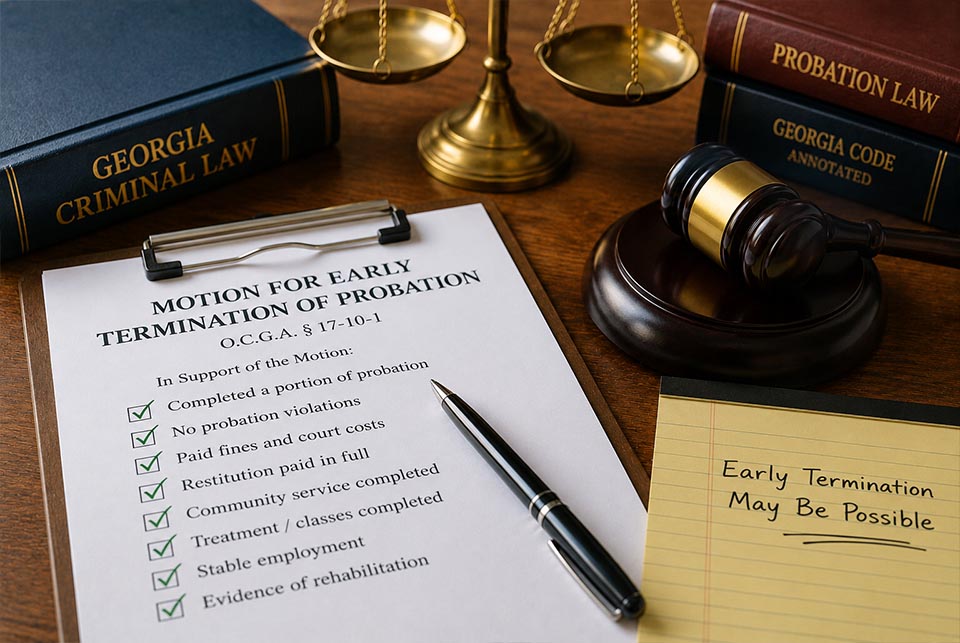
What Helps a Georgia Early Probation Termination Request?
- Completed a meaningful portion of probation
- No serious probation violations
- Fines and court costs addressed
- Restitution paid
- Community service completed
- Required treatment or classes completed
- Stable employment or education
- Stable residence
- No new arrests
- Evidence of rehabilitation
How to Request Early Termination of Probation in Georgia
A person who does not receive an automatic or DCS-initiated termination may be able to ask the sentencing court to shorten probation.
A Marietta criminal defense lawyer can review the original sentencing order and determine whether a motion or petition for early termination is appropriate. The request usually highlights the defendant’s compliance and proves that continued probation is unnecessary. The court may consider factors such as:
- Amount of probation completed,
- Satisfaction of all financial obligations,
- Defendant’s compliance record while on probation,
- Competition of required substance abuse and/or educational programs,
- Defendant’s current living arrangements, including current employment arrangements, and
- Whether continued probation serves a legitimate public-safety or rehabilitative purpose.
Under Georgia law, when a petition to shorten probation is presented, the court is required to set the matter for a hearing as soon as possible and no later than 90 days after receiving the motion.
What Happens at a Georgia Probation Termination Hearing?
If a hearing is scheduled, the defendant may have an opportunity to explain why probation should end early.
A Marietta criminal defense attorney may present evidence showing that the defendant has complied with the conditions of probation and made meaningful progress since the original sentence. Documentation such as proof of completed programs, payment records, employment information, and other evidence of rehabilitation may be helpful.
Likewise, the prosecutor, often at the behest of an alleged crime victim or probation officer familiar with the case, may also have an opportunity to object to early termination.
Ultimately, the sentencing judge decides whether probation should be shortened. Early termination is not necessarily automatic simply because a person has completed a certain percentage of the sentence.
What Happens After Probation Is Terminated Early?
This relief is not just technical. In Georgia, early termination from probation has close to the same effect as an executive pardon.
State law provides that, upon termination of the probated portion of a sentence, the probationer is released from probation and is no longer liable to sentence for the crime for which probation was allowed, subject to the statutory limitations.
Georgia First Offender Act cases are a bit different. Under O.C.G.A. § 42-8-60, qualifying defendants may receive probation without an adjudication of guilt (deferred disposition). Successful completion of the sentence can result in exoneration of guilt and discharge as provided by law.
Many Georgia defendants don’t have to serve the full term of probation. For a free consultation with an experienced criminal defense attorney in Marietta, contact the Phillips Law Firm, LLC. We routinely handle matters in Cobb County and nearby jurisdictions.