
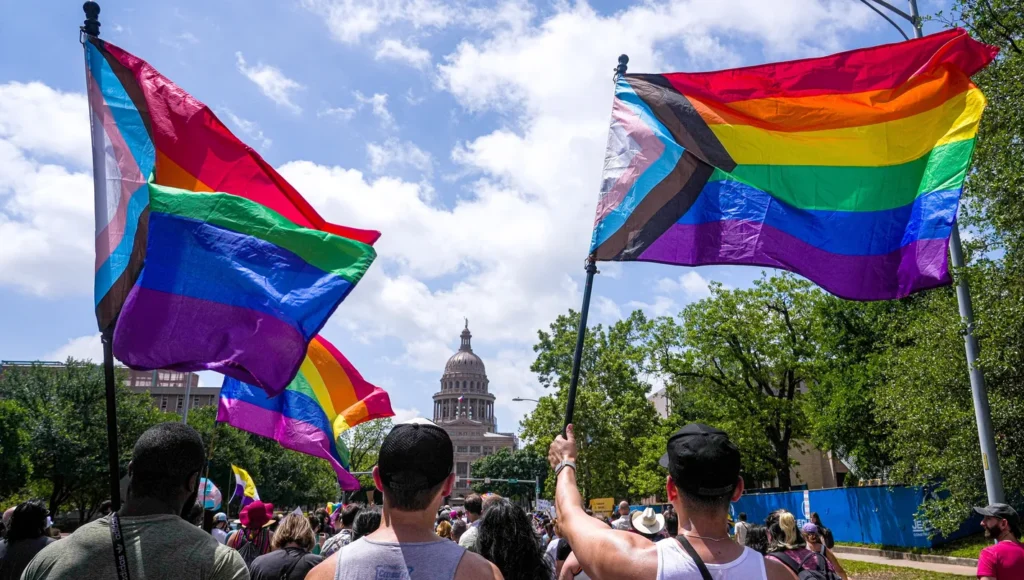
In June 2025, Atlanta police arrested four individuals who allegedly defaced rainbow flags at a crosswalk. Investigators are looking for two others.
When officers responded to a disturbance call at the Piedmont/10th Street district, six suspects were tearing down Pride flags, slashing them with knives, and recording videos of their exploits. They fled on scooters when officers approached.
Within several hours, police arrested four teenagers from Dallas and charged them with obstruction, criminal damage to property, conspiracy, and loitering, the authorities said. One individual is a 16-year-old juvenile.
Under Georgia’s 2020 hate crime law, crimes motivated by the victim’s sexual orientation or gender identity can lead to enhanced penalties. A misdemeanor offense can carry an additional six to twelve months in jail and a fine of up to $5,000.
All four of those arrested could face additional charges under Georgia’s hate crime law, pending the outcome of the investigation, the authorities said. The group coordinated the act and traveled into the city from northwest Atlanta, the authorities said. “We’re still looking at all avenues as far as how that charge will possibly come about,” Sgt. Brandon Hayes of the Atlanta Police Department said at a news conference.
In Taylorsville, Ga., the 16-year-old’s father was cited for failing to supervise his son, according to a news release from the Atlanta Police Department.
“Turning State’s Evidence” Investigations
During the 1970s Watergate investigation, the co-conspirators supposedly got together and agreed to stay quiet until the matter blew over. Less than a month later, one of them testified before Congress, and the dominoes started falling.
Some criminal conspiracies remain shrouded in mystery forever. Generally, however, someone talks sooner or later. Usually, that someone talks because the police promise leniency in exchange for cooperation.
Incidentally, police officers cannot unilaterally make such deals. Prosecutors must propose them to judges, who must approve them.
Most people will say almost anything to get out of trouble or at least reduce their legal troubles. Therefore, “turning state’s evidence” statements are usually unreliable. In court, prosecutors cannot work backwards and argue that if information was true, it was reliable. That’s not how it works. Informer statements stand or fall on their own merits.
These same principles apply to non-conspirator probationers who give leads to investigators. There’s usually another impure motive as well. Generally, Adam tells on Joe to get himself out of trouble and get Joe into trouble. If the police follow up on Adam’s tainted information, the results of that investigation are inadmissible in court, as fruit from a poisonous tree.
The bottom line is that the uncorroborated word of a paid informant, whether the informant got a tangible or intangible payment, usually doesn’t hold up in court.
Gang Crime and Hate Crime Enhancements
Before we address the hate crime enhancement, we should address the gang crime enhancement in Section 16-5-4, because it’s far worse. This 2023 law applies to gang members who commit any:
- Violent crime, or
- Crime that involves possession or use of a weapon.
Specific prohibitions include most kinds of vandalism, criminal trespass, escape or other security-related offenses, and most sex crimes.
Under the law, a street gang is “any organization, association, or group of three or more persons associated in fact, whether formal or informal, which engages in criminal gang activity as defined in paragraph (1) of this Code section.” The law lets prosecutors use circumstantial evidence to prove gang affiliation.
Gang crimes are usually felonies with a maximum sentence of between five and twenty years, even if the underlying offense is usually a misdemeanor.
As mentioned in the above article, the 2020 hate crime enhancement adds penalties to misdemeanors (and felonies) if the defendant targeted the alleged victim because of that person’s:
- Gender,
- National origin,
- Religion,
- Ethnicity,
- Sexual orientation (which usually includes gender identity), and/or
- Disability.
Note that animus is not an element of the hate crime law. Additionally, the defendant’s subjective view is all that counts. If Ben believes Carl is gay, the hate crime enhancement could apply even if Carl is straight.
Additionally, judges often add additional restrictions to hate crime-related probation or parole. For example, the judge might require a defendant to serve almost the entire sentence before considering parole or early probation termination.
As of June 2025, the Georgia Supreme Court has yet to rule on the legality of these enhancements. The gang crime enhancement elevates run-of-the-mill misdemeanors to serious felonies, a jump that may violate the Eighth Amendment’s cruel and unusual punishment provision. The ACLU has already sued to block the hate crime law, arguing that it’s unconstitutionally vague and infringes on First Amendment protest rights.
Favorably Resolving Hate Crimes Charges
These enhancements are very broad and difficult to challenge. So, a Marietta criminal defense lawyer usually focuses on the underlying charges. If the defendant is not guilty of criminal damage to property, or whatever else, enhancements don’t matter.
Let’s stay with Section 16-7-23, the criminal damage to property law. This provision, which prosecutors often use to prosecute individuals who allegedly deface highway crosses or other such objects, makes it illegal to:
- Intentionally damage property of another, if that property is worth at least $500, or
- Recklessly or intentionally, by means of fire or explosive, damage property of another.
“Of another” means prosecutors must prove ownership. Usually, anonymous sympathizers and well-wishers place flowers on graves and flags in crosswalks. Identifying one owner, let alone getting that person to testify in court, is usually quite a chore.
Second, the item must have a financial value of at least $500. To many people, ripping a Pride flag is like burning a U.S. flag. The emotional damage is incalculable. But most outdoor Pride, U.S., and other flags are available on Amazon for under $50.
A similar issue comes up in personal injury cases that involve the death of a pet. State law usually limits recovery in these cases to the pet’s economic value. The pet’s emotional value means nothing. Stiff enhancements have a substantial shock and awe factor, but in the end, they’re no different from other criminal matters. For a free consultation with an experienced Marietta criminal defense lawyer, contact The Phillips Law Firm, LLC. We routinely handle matters in Cobb County and nearby jurisdictions.